For Makers
9 min readSEO for Makers: What Luma Does for You, and the Part Only You Can Do
David · Co-founder ·
You don’t need to become an SEO expert to get found on Google. Luma handles the technical side automatically. Here’s what happens when you publish a listing, and the handful of things only you can do.
Most SEO advice reads like a second job. Keyword research tools, backlink strategies, meta tags, structured data. If you sell handmade work for a living, none of that is what you signed up for.
If you’ve run your own website shop, you’ll already know the rabbit hole. If you haven’t, you don’t need to.
SEO splits in two. We’ve built the technical half into the platform. It runs under every listing you publish and you never have to look at it. The half that decides whether a shopper finds your work is the one only you can do, and it isn’t technical at all. It’s describing your work truthfully and specifically.
What happens when you publish on Luma
The moment a listing goes live on Luma, a few things happen without you touching anything.
Your listing gets a clean web address built from your title. It joins the sitemap Google crawls, and we push new and changed listings straight to Bing and the AI search tools that read it, so fresh work doesn’t sit invisible for weeks.
Behind the page, we attach the structured data Google needs to show more than a link: your price, whether the item is in stock, your dispatch and delivery estimate, the returns policy that applies, and your review rating.
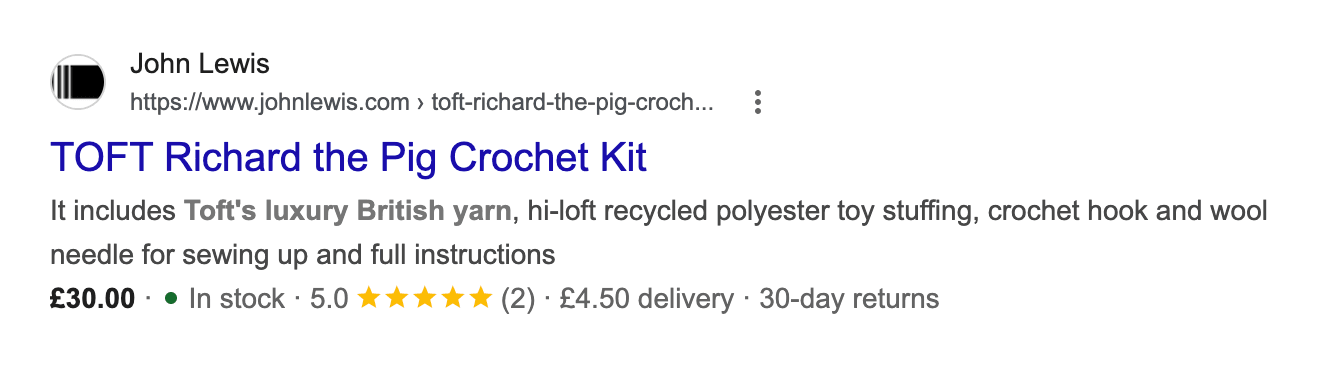
You’ll have seen what that looks like without thinking about it. Some Google results are a blue headline and two lines of grey text. Others carry a price, a row of stars and what delivery costs underneath. The second kind is what structured data buys you, and it’s the one a shopper’s eye lands on.
None of this requires a plugin, a setting, or a checkbox. It’s built into every shop on Luma, from the first listing.
The one thing we won’t do is write your listing for you. We could: the technology to generate an AI description from a photograph already exists, and it isn’t expensive. But a marketplace whose descriptions are written by a machine is just a catalogue, and the words that sell handmade work are the ones only the person who made it can write.
Your title is what shoppers type
Google matches searches against words. If your title is "The Hygge Collection No. 4", the only people who can find it are the ones who already know it exists.
Think about what someone types when they want the thing you’ve made. "Hand-thrown stoneware mug, speckled glaze" is a title a shopper can find. It also becomes your listing’s web address, so the words do double duty.
You don’t have to strip the personality out. Lead with the plain description and let the collection name follow it: "Hand-thrown stoneware mug, speckled glaze, from the Hygge Collection".
Your first sentence is your Google snippet
The grey text under a Google result comes from your listing description. We take the first 160 characters, cut at a whole word, so the opening sentence carries the weight.
Front-load it: what it is, what it’s made from, who it’s for. "A hand-thrown stoneware mug in a speckled oatmeal glaze, thrown on the wheel in my Sheffield studio" tells a searching shopper enough to click. Save the story of your studio dog for paragraph three. People will read it once they’re on the page.
The description box reminds you how much a search result will show, and says so if what you’ve written is too thin to give a shopper much. The title box does the same when a title runs longer than a result has room for.
They’re notes. Everything publishes exactly as you wrote it, and you’re free to ignore all of it. Your listing is yours to word.
Name your materials
Materials are what long-tail shoppers search for. Nobody types "quality mug" into Google; they type "stoneware mug" or "merino wool scarf" or "reclaimed oak shelf". Naming the material puts those exact words on your page.
The same field powers the filters shoppers browse Luma with, and naming at least one material earns your listing a small boost in our own search ranking. Nobody has to fill it in. It’s a lever every maker controls from day one, and it rewards telling shoppers what their work is made of. Getting found on Luma covers everything else our search takes into account.
"How it’s made" earns you a richer result
Your process description isn’t only a trust signal for shoppers. Google reads it too.
The process, delivery and personalisation details on your listing feed the question-and-answer information Google can show directly in results. A listing with a real process description has more to show than one without.
A short process video goes further. Film thirty seconds of the piece being made: the wheel spinning, the loom in motion, the torch on the silver. We generate the markup that lets that clip appear in video search results, with a thumbnail you pick yourself. You don’t need a rig either; a phone propped against a jar, in the light you already work in, is enough.
That footage is a real obstacle for anyone reselling factory stock, and thirty seconds of easy work for you. You already have the thing they’d have to fake.
Like materials, process media earns your listing a small boost in Luma’s own search ranking, and the same clip helps us verify that listings are genuinely handmade. None of that is a hoop we make you jump through. It’s the quickest way to show a shopper, Google and us at once that the work is yours, and you only have to film it once.
Reviews put stars under your listing
When your listing has reviews, its Google result can show a star rating. Stars pull the eye, and they pull clicks.
You can’t write your own reviews, and there’s no trick worth trying here. Reviews follow delivered orders. That’s the whole mechanism. Post when you said you would, wrap it so it arrives intact, and reply kindly when someone leaves feedback. The stars come from that, in their own time.
If a review is unfair, or it’s about something you had no control over, flag it and tell us why. It stays up while we look, and we’ll take it down if we agree it breaks our guidelines. What we won’t do is remove a review for being negative. You wouldn’t trust the stars on a marketplace that did.
Fill in your dispatch and delivery times
Google can show a shopper when an item will arrive, and it takes those numbers straight from the dispatch window and delivery estimate on your listing. It takes a minute to fill in, and shoppers weigh it before they click.
Be realistic rather than optimistic. The estimate feeds your on-time record too.
Does holiday mode hurt you?
No, though it’s worth knowing what it does. Switch holiday mode on and your listings are marked unavailable to Google until you’re back. That’s not a penalty. It stops a shopper finding your mug, clicking through, and discovering they can’t buy it. Accurate beats visible.
What not to do
A few shortcuts get suggested a lot. These are the ones to skip.
Keyword stuffing is the obvious one. A title reading "gift for her mothers day birthday christmas mug cup ceramic pottery" looks like spam to Google and to every human who sees it. Misleading titles are worse: they get you clicks and then refunds.
The one we see most is padding. You ask a chatbot to make your description more SEO-friendly and paste back two hundred words of timeless elegance and perfect for any occasion. It buries the one sentence that says what the thing actually is, it reads identically to every other listing that did the same, and the shopper who wanted to know about your glaze has already scrolled past.
On Luma there’s an extra reason to stay honest: the same description that ranks your listing is the one our team reads when checking it against our handmade standards.
The honest version of SEO
We won’t promise you page one of Google. Nobody can, and SEO is slow. Weeks and months, not days.
But the technical side is built and running under every listing you publish, and where your part of it is easy to show you, we show you. Your part fits on an index card: a title shoppers would type, a first sentence that says what it is and what it’s made from, your materials named, your delivery times filled in.
Describe your work the way you’d describe it at a market stall to someone who’s just picked it up. That’s all good SEO has ever been. We’ve done the rest.
Common questions
How long does SEO take for a new listing?
Weeks, usually, and sometimes months. Google’s index runs to hundreds of billions of pages and its crawlers work through the web continuously, so a brand-new listing joins the back of a very long queue. Google then has to work out what your page is about and watch whether the shoppers who click on it stay. We push new listings to Bing and the AI search tools the moment you publish, which is quicker, but nothing in search is instant. Publish steadily rather than waiting on any one listing to land.
Do I have to fill in materials and tags?
No. Neither is required and you can publish without them. They’re worth the two minutes though, and they do different jobs. Materials feed Luma’s filters and earn your listing a small ranking boost. Tags catch the other names for your work: a trinket dish is also a ring dish and a catch-all, and a shopper searching for one of those won’t find you unless you’ve said it somewhere.
Does a longer description rank better?
Not by length. A short description that says what the thing is, what it’s made from and how it was made will beat a long one padded out to hit a word count. Extra words only help when they’re real ones.
Tagged: SEO for makers, handmade SEO, SEO for makers selling handmade, craft business SEO, get found on Google, handmade marketplace UK, UK makers, luma market
Written by David, co-founder of Luma Market.
Get the next one by email
Occasional notes on what we’re building and what we’re learning. No more than once a fortnight.